
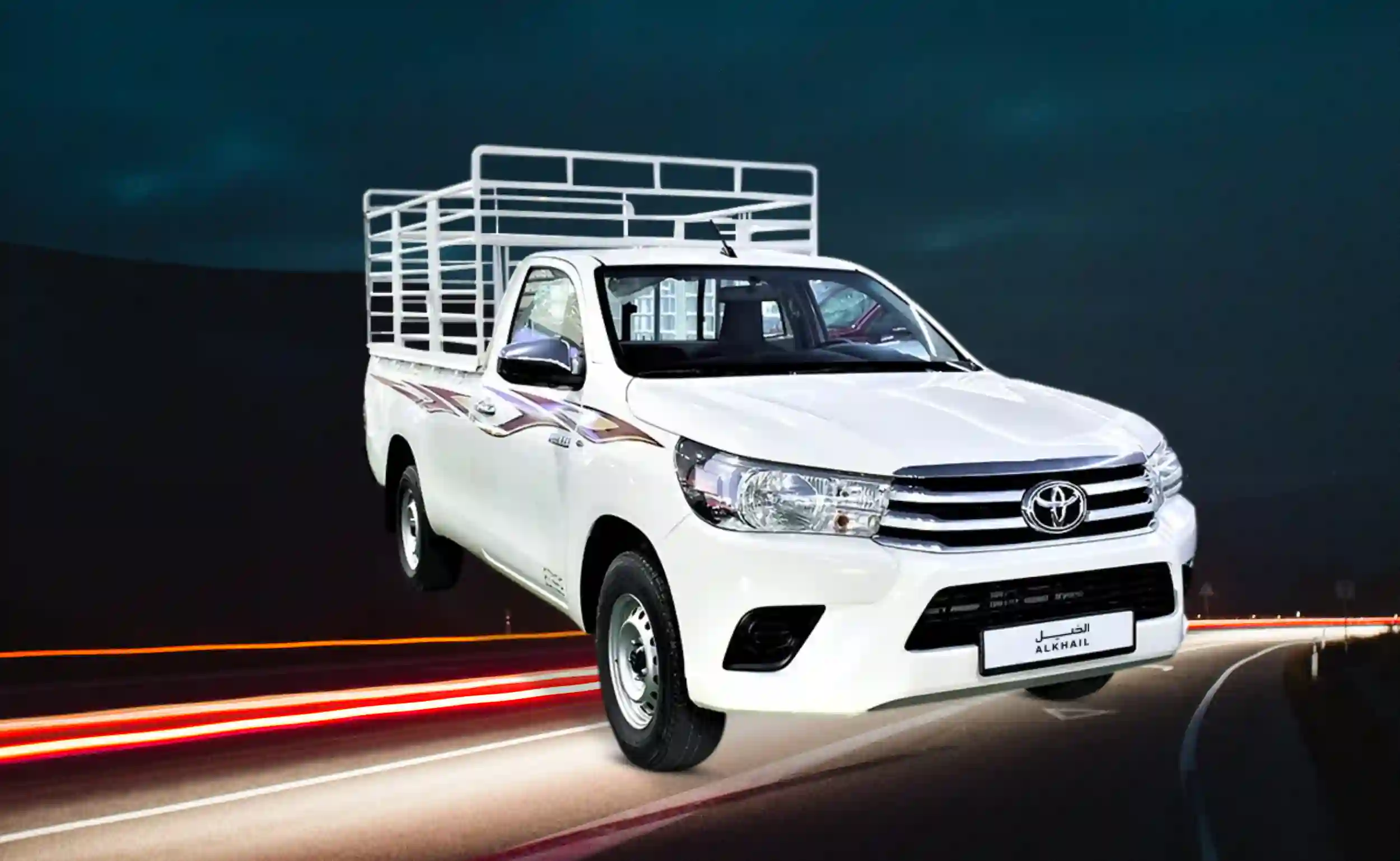


How much weight can a 3 ton pickup actually carry? Not the number most people assume. “3 ton” is a class label, not a guarantee that you can load exactly 3,000 kg of cargo—the real ceiling depends on GVWR, the vehicle’s own weight, and how your load is distributed across the deck. Understanding the difference before you book is what keeps a delivery on schedule instead of turning into an overload problem at the first weigh-in.
Quick answer: GVWR (Gross Vehicle Weight Rating) is the maximum total weight a truck is legally and structurally allowed to carry—vehicle plus cargo plus driver combined. Payload is what’s left over for cargo once the vehicle’s own weight (curb weight) is subtracted from the GVWR. A 3-ton pickup’s “3-ton” label refers to its class, and on Haulier Transport’s Dubai fleet, the usable payload on this class is rated up to 3,000 kg, with a 14–16 ft deck that typically holds four to six standard pallets.
What Does 3 Ton Actually Mean on a Pickup?
“3 ton” is shorthand the transport industry uses to describe a class of medium-duty pickup, not a literal promise that you can stack exactly 3,000 kg of goods onto the bed and drive off. It’s a naming convention, similar to how a “1 ton” or “7 ton” pickup signals roughly where that vehicle sits in the payload range—small, medium, or heavy commercial cargo.
The confusion usually starts here: people assume 3 ton is the cargo limit when it’s actually closer to a rounded description of the vehicle’s rated carrying capacity class. The number that actually governs what’s safe and legal to load is the GVWR.
GVWR Explained: The Number That Actually Sets the Limit
GVWR stands for Gross Vehicle Weight Rating. It’s the maximum total weight the manufacturer certifies the vehicle can safely carry—everything included: the truck itself, fuel, driver, passengers, and cargo. It’s set by the manufacturer based on the chassis, axles, brakes, suspension, and tires, and it doesn’t change no matter who’s renting the vehicle or what they’re hauling.
GVWR vs. Curb Weight vs. Payload
These three numbers are related by one simple equation, and mixing them up is the single most common mistake people make when estimating capacity:
Payload = GVWR − Curb Weight
- GVWR—the absolute maximum the vehicle is rated to weigh, fully loaded.
- Curb weight—how much the empty vehicle weighs on its own (chassis, body, fuel, fluids—no cargo, no driver).
- Payload—what’s actually left over for cargo, driver, and passengers once curb weight is subtracted from GVWR.
So when a rental listing quotes “payload up to 3,000 kg,” that figure has already accounted for the truck’s own weight. It’s the number that matters for planning your load—not the GVWR itself, and not the “3 ton” class name.
Where to Find the Real GVWR for a Specific Vehicle
GVWR varies by manufacturer, model year, and configuration—a box-body 3-ton pickup and a flatbed 3-ton pickup from different manufacturers won’t share an identical GVWR figure. The only reliable source for the exact certified number is the compliance plate fitted to that specific vehicle (usually on the driver’s door frame or chassis) or the registration documentation held by the operator. Any general figure you read online—including in this guide—should be treated as a planning reference, not a substitute for checking the actual vehicle before a heavy or borderline load.
How Much Weight Can a 3 Ton Pickup Actually Carry?
On Haulier Transport’s Dubai fleet, the 3-ton pickup is rated for a payload of up to 3,000 kg, with a loading deck of roughly 14–16 ft. In practical terms, that usually translates to four to six standard pallets, depending on how the pallets are packed and how the weight is distributed across the bed.
Payload in Pallets, Boxes, and Everyday Cargo
Weight limits are easier to plan around once you translate them into things you can actually picture loading. Here’s a rough reference—actual weights vary by product and packing density, so treat this as a planning guide, not an exact calculation:
| Cargo Type | Typical Weight | Fits a 3-Ton Pickup? |
|---|---|---|
| Standard pallet of packaged goods | ~200–400 kg each | Yes—4 to 6 pallets |
| Full apartment furniture set (sofa, bed, wardrobe, boxes) | ~800–1,500 kg | Yes, in most cases |
| Bags of cement (50 kg each) | 50 kg per bag | Yes, up to roughly 50–55 bags |
| Ceramic floor tiles (per pallet) | ~1,000–1,500 kg per pallet | Yes—typically 1–2 pallets max, since tile pallets are dense. |
| Full villa furniture load (multi-room + appliances) | 3,000 kg+ | Usually needs a larger vehicle or two trips |
| Warehouse-to-warehouse bulk stock run | Varies widely | Depends entirely on product density—confirm weight before booking. |
Dense materials like tiles, cement, or steel reach the weight limit long before they fill the deck space. Bulky-but-light cargo like furniture or empty cartons often fills the available deck length before it gets anywhere near 3,000 kg. Both situations are normal—the deciding factor is whichever limit you hit first, weight or volume.
How to Estimate Your Load Before You Book
A rough estimate before booking avoids the two most expensive mistakes: paying for a truck that’s too big or showing up with a load the vehicle can’t legally carry.
- List what’s actually moving. Walk through the space or the stock list and count items rather than guessing.
- Estimate weight by category, not by volume. A room full of boxes can look large but weigh very little; a single pallet of tiles can look small but weigh a lot.
- Add it all up and compare it to the payload figure, not the 3 ton name.
- Factor in how it will sit on the deck. Concentrated heavy items (machinery, tile pallets) need to sit low and centered—this affects handling even if you’re technically under the weight limit.
- When in doubt, ask. Haulier Transport’s team can confirm whether a specific cargo description fits a 3-ton pickup or needs a 7-ton or 10-ton vehicle instead.
What Happens If You Overload a 3 Ton Pickup
Loading beyond the rated payload isn’t just a paperwork issue. An overloaded vehicle handles differently—braking distance increases, tire wear accelerates, and the suspension and axles are put under stress they weren’t designed for, which raises the risk of mechanical failure or an accident. Overloaded commercial vehicles can also be flagged during roadside checks in the UAE, which can mean delays, fines, or a vehicle being pulled from service mid-route. None of that is worth the saving from skipping a second trip or a larger truck.
Common Mistakes When Estimating Pickup Weight Capacity
- Treating 3 ton as the cargo limit instead of checking the actual payload rating.
- Estimating by volume only, missing that dense materials (tiles, cement, machinery parts) hit the weight ceiling long before the deck looks full.
- Ignoring how weight is distributed across the bed, which affects handling even within the rated payload.
- Not accounting for pallet weight variation—two pallets of the “same” product can differ significantly depending on packing.
- Assuming every 3-ton pickup has an identical GVWR, when body type and manufacturer both affect the certified figure.
- Skipping a weight check on borderline loads and finding out the load is too heavy after it’s already on the truck.
Dubai Considerations: Loading Zones, Access, and Compliance
Dubai’s commercial loading environment adds a few practical factors on top of the weight calculation itself. Basement loading areas in towers across Business Bay and Downtown Dubai often carry their own height and weight restrictions, separate from the vehicle’s GVWR. Industrial zones like Al Quoz, JAFZA, and Dubai Investment Park generally accommodate medium-duty pickups without issue, since forklift and dock loading are standard there. Roadside checks apply UAE weight regulations regardless of location, so a load that’s within the deck’s physical space but over the rated payload is still a compliance risk anywhere in the city, not just in restricted zones.
How Haulier Transport Can Help
If your cargo sits close to the payload limit, or you’re not sure whether it needs a 3-ton, 7-ton, or 10-ton vehicle, sharing the cargo type, rough weight, and pallet or item count with Haulier Transport lets the team confirm the right vehicle before dispatch rather than after loading has started. Haulier Transport’s 3-ton pickup truck rental in Dubai runs with a payload of up to 3,000 kg, a 14–16 ft deck, forklift and dock-loading compatibility, and open bed, box body, curtain side, and refrigerated configurations—with a commercially licensed driver included on every booking.
Frequently Asked Questions
What does GVWR mean on a truck?
GVWR (Gross Vehicle Weight Rating) is the maximum total weight a manufacturer certifies a vehicle can carry, including the truck itself, fuel, driver, and cargo combined. It’s the ceiling everything else is measured against.
How much weight can a 3-ton pickup actually carry?
On Haulier Transport’s Dubai fleet, the rated payload is up to 3,000 kg, with a 14–16 ft deck that typically holds four to six standard pallets, depending on cargo density and packing.
What’s the difference between payload and GVWR?
GVWR is the vehicle’s total certified weight limit, including the truck itself. Payload is what’s left over for cargo once the vehicle’s own curb weight is subtracted from the GVWR—it’s the figure that actually matters for planning a load.
How many pallets fit on a 3-ton pickup?
Typically four to six standard pallets, depending on the weight and dimensions of the goods on each pallet. Dense cargo like tiles or cement reaches the weight limit with far fewer pallets than lighter, bulkier goods.
Does 3 ton mean the truck weighs 3 tons or carries 3 tons?
Neither exactly—”3 ton” is an industry class label describing the vehicle’s approximate payload range. The precise, usable cargo limit is the rated payload figure (up to 3,000 kg in this class), not the truck’s own weight.
What happens if a pickup is overloaded in Dubai?
Overloading increases braking distance and mechanical stress, raises accident risk, and can result in fines or a vehicle being pulled from service at a roadside weight check. Staying within the rated payload avoids all of this.
Can a 3-ton pickup carry a full villa’s worth of furniture?
Usually not in one trip. A full villa load with multiple rooms and appliances often exceeds 3,000 kg, so a larger vehicle or a two-trip plan is generally the more practical option—Haulier Transport can advise based on the actual inventory.
Is the GVWR the same for every 3 ton pickup? No. GVWR varies by manufacturer, model, and body configuration. The compliance plate on the specific vehicle is the only authoritative source for its exact certified figure.
Final Takeaway
3 ton pickup weight capacity comes down to one number that actually matters: the rated payload, not the class name on the listing. Once you know your cargo’s approximate weight—not just how much space it takes up—matching it to the right vehicle is straightforward. Need help confirming whether your load fits a 3-ton pickup or needs something larger? Share the cargo type, approximate weight, and pickup/delivery details with Haulier Transport so the right vehicle can be arranged.
