


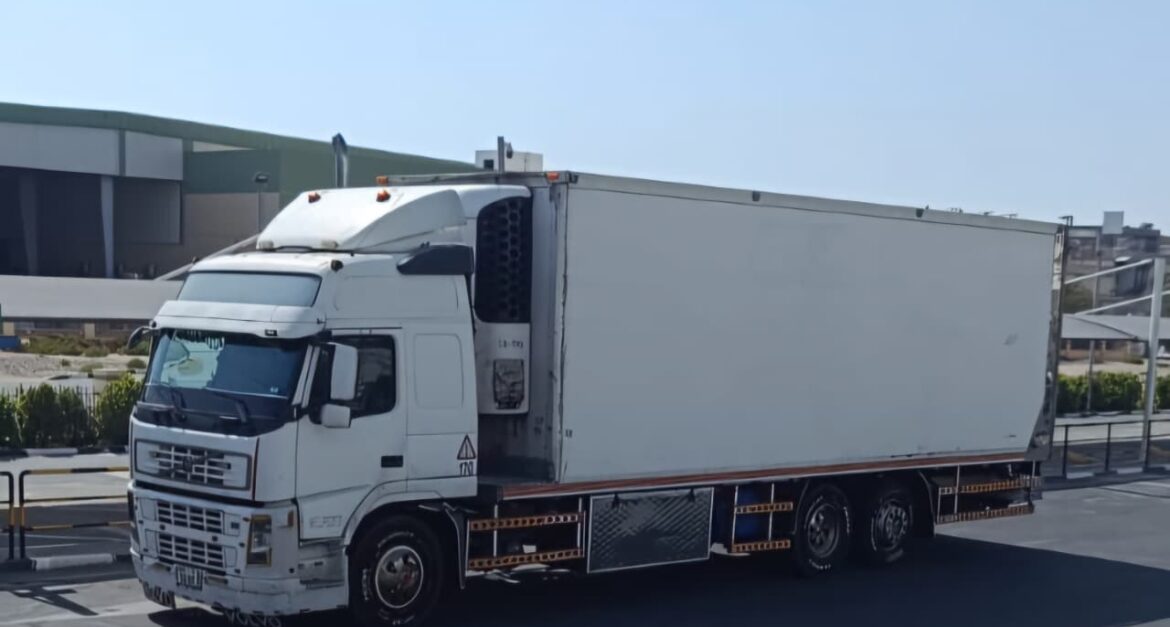
Ask five transport managers what a 40 ft trailer can carry and you will get five different answers. That is because 40 ft only describes the length of the deck. It says nothing about what the trailer can legally weigh, how high your cargo will sit, or whether your site has any way of loading it.
If you called us with a load and no idea what trailer it needs, this is the order we would go through things: weight, legal limits, height, loading, route. Skip one and it usually turns up later as a delay or a fine. Anyone who types choose 40 ft trailer heavy commercial cargo UAE into a search bar is really asking one thing: which trailer will carry my load legally and safely? The rest of this page answers that.
Start with the weight you really have
The weight on a packing list is usually the net weight of the goods. The road does not care about that number. It cares about everything sitting on the deck. So add the pallets, crates and skids. If it is a machine, add the oil, the fuel, the bucket, the counterweights, anything that travels with it. If it is steel, add the bundling and dunnage. The real number is often further from the quoted one than people expect.
Then ask where that weight will sit. 28 tonnes spread along the whole deck is an easy load. The same 28 tonnes over one metre of deck is a different problem, because one axle group ends up doing most of the work.
Here is a rough example. A prime mover weighs about 9 tonnes empty and the trailer about 7.5. Add a 28-tonne fabricated steel package and you are near 44.5 tonnes, which looks fine for a multi-axle combination. But if the package sits toward the rear of the deck, the trailer’s axle group can go over its own limit while the total is still legal. These are round numbers to show the idea, so use the real weights from your vehicle registration and the equipment plates. Rule one of choose 40 ft trailer heavy commercial cargo UAE” is simple: know the real gross weight before you look at any trailer.
What the UAE allows
Heavy vehicle weights and dimensions are set at federal level under Cabinet Resolution No. 138 of 2023. Emirate authorities such as the RTA enforce them and add their own rules. These are the numbers that matter most for a 40 ft trailer.
| Axles on the combination | Maximum total weight |
|---|---|
| 2 | 21 t |
| 3 | 34 t |
| 4 | 45 t |
| 5 | 56 t |
| 6 or more | 65 t |
| Axle type | Maximum weight |
|---|---|
| Single steering axle | 8 t |
| Single non-steering axle | 13 t |
| Tandem (2-axle) group | 26 t |
| Tri-axle group | 33 t |
The overall size limit for a tractor and semi-trailer is about 2.6 m wide, 4.6 m high and 28 m long.
Fines are charged per trip. Overweight is charged per tonne, each axle group that is over is charged separately, and exceeding the dimensions is fined again. If total weight and axle weight are both wrong on the same trip, the higher fine applies rather than both.
One honest warning: enforcement dates and local time restrictions have been revised more than once, so do not treat any article, this one included, as the final word. Check the current position with the Ministry of Energy and Infrastructure or the RTA before a move, especially if it crosses an emirate border.
Height catches more people than weight
The sum is simple. Deck height, plus cargo height, plus any cradle or packing, has to stay under the legal height limit of 4.6 m. On a standard flat deck, a 3.4 m excavator leaves very little room. Add a mirror, a beacon or an exhaust stack and you can be over the line without realising it. A drop deck or low deck gives that margin back, though usually with a shorter flat section and a different way of loading.
Width works the same way. Cargo that is already close to 2.6 m has no tolerance for outriggers, overhanging attachments or fixings. Ask for the real deck height of the trailer you are being offered, in metres, not the name of the trailer type. Two trailers sold under the same name can be noticeably different.
If the cargo cannot be reduced or split to fit, it may have to move as a non-dividable load under a permit, with conditions on route and timing. That affects your schedule more than the trailer, so find out early. Rule two of “choose 40 ft trailer heavy commercial cargo UAE”: do the height and width sum before you accept a trailer, not after it is loaded.
Think about loading before you think about the trailer
A trailer only helps if the cargo can get onto it. Picture the right trailer arriving at a site where the only forklift is rated well below the cargo weight. Or the crane cannot get close enough because the trailer has no room to turn in the yard. It happens more than it should.
So work backwards from how the cargo will be lifted:
- Crane from above: you want an open deck with nothing in the way.
- Forklift from the side: an open or side-accessible deck, and check the forklift’s real capacity at lifting height, not the number on the label.
- Driven on under its own power: ramps rated for the machine’s weight, with a gentle approach angle so nothing scrapes.
- Container: a deck with locking points that match the container.
- Palletised goods that must stay clean and dry: side protection such as curtains.
- Long rigid items like pipes or beams: full usable deck length, plenty of anchor points, and stakes.
For “choose 40 ft trailer heavy commercial cargo UAE” jobs, the loading method is the point most buyers skip, so confirm it first.
Then look at the route
A trailer that is legal at the loading point is not automatically practical for the whole journey. Before you commit, check:
- Time restrictions. Heavy vehicles can face time-of-day limits in some areas, so the best route on a map may not be the one you are allowed to drive at that hour.
- Bridges, tunnels and low points. Your height calculation only matters if the route respects it.
- Port and terminal gates. Each has its own paperwork and vehicle requirements.
- Crossing emirates. A Dubai to Abu Dhabi run can involve different local rules from a move within Dubai.
- Summer heat. An open steel deck gets very hot. It affects sensitive cargo like plastics and packaged goods, and long hot runs put real stress on the tyres of a heavy combination.
- Wind and sand. Light or tall loads on an open deck need extra securing and sometimes a cover.
Matching cargo to trailer, in plain terms
Don’t choose by industry. A construction firm and a food manufacturer can need exactly the same trailer if their cargo behaves the same way.
| What the cargo is like | Usually points to | Watch for |
|---|---|---|
| Heavy and compact | Multi-axle trailer with a high axle-group rating | One axle group carrying too much |
| Long and rigid | Full-length flat deck with many anchor points | Rear overhang, load flexing |
| Tall and heavy | Low or drop deck | Height limit, ramp angle, ground clearance |
| Wheeled or tracked machine | Deck with ramps for driving on | Ramp strength, marks on the deck |
| Palletised goods | Side-protected trailer | Weight limit often hit before space runs out |
| Standard ISO container | Deck with container locking points | Container’s real gross weight versus road limits |
| Odd-shaped project cargo | Work it out after weight and size are confirmed | Permit and possibly an escorted move |
Securing: the part people rush
Securing decides whether the trailer you picked can actually carry the load. A commonly used European standard, EN 12195-1, designs for forces of roughly 0.8 g forward and 0.5 g sideways and backwards under braking and turning. You don’t need to memorise that. You just need to know the straps and chains must be rated for the cargo’s weight, not for convenience.
In practice:
- Count the anchor points on the deck and check how strong they are.
- Look at the working load limit (WLL) of straps and chains, not the breaking strength.
- Use edge protectors on sharp corners.
- Block and brace heavy items. Friction alone is not a plan.
- Check tension again after the first few kilometres.
Mistakes worth avoiding
- Using net weight instead of gross. Everything on the deck counts.
- Checking the total but not the axle groups. The total can be legal while one group is over.
- Forgetting the deck height. The cargo’s own height is only half of the sum.
- Picking the trailer before checking how it will be loaded. The site matters as much as the equipment.
- Trusting a container’s declared weight as a rough guess. Get the verified figure.
- Leaving a permit to the day before. Non-dividable loads need lead time.
Every one of these mistakes can be avoided by running “choose 40 ft trailer heavy commercial cargo UAE” as a checklist: weight, height, loading, route.
From our dispatch desk
[ADD YOUR OWN STORY HERE. Four to six sentences about one real job: what the cargo was, what almost went wrong (weight, height, loading access, route), and what you changed. Use real numbers and, if possible, a real photo from the job. Delete this note once written.]
Frequently asked questions
How do I work out the payload I can legally carry?
Take the empty weight of the prime mover and trailer away from the lowest applicable limit, which is either the total combination limit or an axle-group limit. Then check that where the load sits keeps every axle group inside its own limit.
Does “40 ft” always mean a 40 ft deck?
Not always. Overall length, usable deck length and loadable length can differ depending on the design. Ask for the usable deck length in metres.
Is a three-axle trailer always better than a two-axle one?
No. More axles allow more legal weight and spread the load, but they also add empty weight and can be harder to manoeuvre on tight sites. Choose from the cargo’s weight and position.
Can a 40 ft trailer carry a loaded 40 ft container?
It depends on the container’s actual gross weight and the trailer and axle-group limits. A container can be fine for the ship and still too heavy for a road combination, so check the verified gross mass.
Does summer heat change which trailer I should choose?
It changes the cargo protection and the securing more than the trailer length. Heat-sensitive goods may need covering, and tyres and brakes should be in good shape before long summer runs.
