


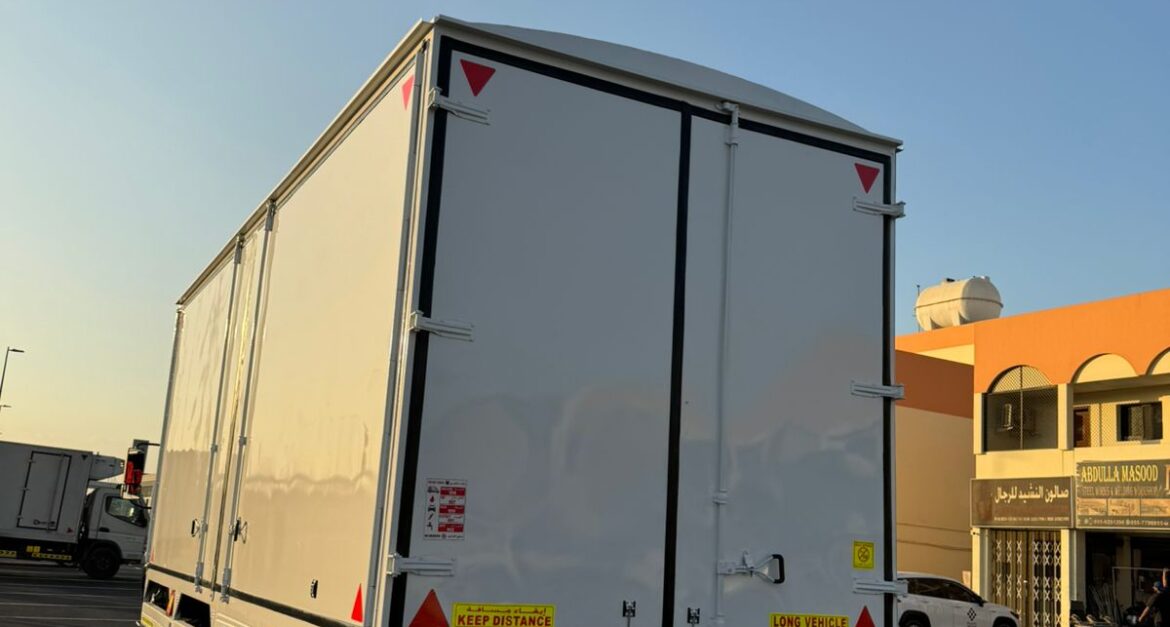
How to Choose the Right Truck Size in Dubai for Your Load
Most people call us with the weight of their shipment and not much else. That’s understandable—weight is the number that feels most concrete. But weight on its own rarely tells you which truck you actually need. A pallet of tiles and a van full of flat-pack furniture can weigh close to the same amount and need completely different vehicles. A sofa set can be light enough for a small pickup and still be too bulky to fit in one.
The truck that suits your job depends on how much your cargo weighs, how much space it takes up, how it needs to be loaded, and — in Dubai specifically — whether the vehicle can actually get to your building. That last part surprises a lot of first-time movers, and it’s where this guide spends more time than most.
This is written for anyone trying to work out which vehicle fits their load: furniture, warehouse stock, construction materials, event supplies, catering goods, or anything that needs to stay chilled or frozen in transit.
Start With the Cargo, Not the Vehicle | Truck Size Guide Dubai
Before you ask what size truck, it helps to answer a few questions about what’s actually being moved:
- What’s the approximate total weight?
- How much physical space does it take up?
- What are the dimensions of the largest pieces?
- How many boxes or pallets are involved, and can they be stacked?
- Is a forklift or loading bay available, or will it be loaded by hand?
- Can a larger vehicle actually reach the pickup and drop-off points?
- Will this need one trip, or several?
- Does anything need to stay chilled, refrigerated, or frozen?
The more specific you can be at the quotation stage, the less likely you are to end up undersized on moving day.
Why the Right Size Actually Matters
Go too small and you’re looking at repeat trips—more loading, more unloading, more driver time, and a job that takes twice as long as it should. Go too large and you can run into the opposite problem: a truck that can’t get near enough to your building to actually be useful.
Dubai makes this second issue more common than people expect. A warehouse transfer in Ras Al Khor is a completely different logistics problem from a furniture delivery to a tower in Business Bay, which is different again from a catering drop at an event venue with a tight loading window. Capacity is only half the equation — access is the other half, and it’s the half most guides skip.
Building Access Is Often the Real Constraint
This is the part that catches people out. In many parts of Dubai, the size of truck you can use matters as much as the size you need.
High-rise buildings in areas like Dubai Marina, Downtown, JBR, and Business Bay often have loading bay height limits and restricted basement access, which caps the practical truck size well below what a villa community would allow. Most residential towers also require move-in or move-out permission (commonly an NOC) plus a booked service elevator slot before a truck is allowed on site—and that booking can take anywhere from two to three days, sometimes closer to a week, depending on the building. Villa communities such as Arabian Ranches or Dubai Hills Estate are generally far more flexible, with fewer restrictions on vehicle length.
If you’re arranging a move or delivery to a high-rise, it’s worth checking the building’s loading procedure and elevator booking lead time before you lock in a truck size — a bigger vehicle isn’t much help if it can’t reach your loading bay in time.
Matching Truck Size to Load
Once you know your cargo’s weight, volume, and access requirements, the table below is a reasonable starting point—though actual payload always depends on the specific vehicle, body type, and how the cargo is packed.
| Vehicle | Common uses | Suits |
|---|---|---|
| 1 Ton | Small deliveries, light commercial goods, compact moves | Light, compact cargo |
| 3 Ton | Medium deliveries, furniture, retail stock, smaller relocations | Moderate weight or volume |
| 5 Ton | Larger commercial deliveries, office moves, event equipment | A bigger volume than 1–3 ton can be handled. |
| 7 Ton | Heavy commercial cargo, warehouse stock, large moves, construction materials | Substantial loads beyond smaller vehicles |
| 10 Ton | Industrial equipment, high-volume distribution, heavier loads | Higher capacity requirements |
| 40 Ft Trailer | Large freight, container-related movements, high-volume cargo | Trailer-scale transportation |
A rough way to think about the range: a 1-ton pickup handles a light, compact job comfortably—a few boxes, a small delivery, nothing that needs much floor space. Step up to a 3-ton once you’re dealing with a full apartment’s worth of furniture or a regular retail run. A 5-ton or 7-ton becomes the sensible choice once you’re moving palletized warehouse stock, a full villa, or construction materials in real volume—the jump from 5 to 7 ton is usually about volume and pallet count more than raw weight. Beyond that, a 10-ton or 40 ft trailer is for industrial-scale or freight-level cargo, where a standard pickup wouldn’t have anywhere near enough deck space.
If you’re trying to decide specifically between 3 ton, 5 ton, and 7 ton for your job, we’ve broken that comparison down in more depth, including deck dimensions and typical bed length, in our 3 ton vs 5 ton vs 7 ton pickup guide. If your shipment lands closer to the heavy end of that range, our 7-ton pickup fleet is built for exactly that kind of load. Lighter jobs are usually better served by a 1-ton or 3-ton pickup, and anything beyond 10-ton territory typically points to a 10-ton truck or a 40 ft trailer.
What to Actually Measure Before Booking
Cargo weight. Dense materials — machinery, tiles, metal stock, construction supplies — hit a vehicle’s payload limit fast, sometimes before the cargo bed is even close to full.
Cargo volume. This is where furniture, retail stock, and event equipment catch people out. A truck can have plenty of payload capacity left and still run out of usable space.
Dimensions. Wardrobes, long materials, exhibition structures, and anything that needs to stay upright can demand more room than their weight suggests.
Pallet count. If you’re a warehouse or distributor, tell your provider the number of pallets, their approximate size, weight per pallet, and whether they can be stacked. That single detail usually does more to narrow down the right vehicle than any other piece of information.
Loading conditions. Manual loading, forklift access, a proper loading bay, or none of the above—all of it changes what’s practical, regardless of what the truck can theoretically carry.
Number of trips. The cheapest-looking truck on paper isn’t always the cheapest job. If a smaller vehicle means two or three trips instead of one, the extra loading, unloading, and driver time can outweigh whatever you saved on the rental.
Which Truck Suits Warehouse Delivery?
It depends on frequency as much as volume. A small stock top-up might only need a smaller commercial vehicle, while a full palletized shipment could call for a 5-ton, 7-ton, or 10-ton truck depending on weight and pallet count. If you’re doing several small deliveries a week rather than one large weekly transfer, the vehicle that makes sense for a bulk run isn’t necessarily the most efficient one for daily drops—it’s worth thinking through both scenarios separately if your business does a mix of both.
Which Truck Suits a Furniture Move?
Furniture is the clearest example of why weight alone is the wrong metric. A sofa, wardrobe, or bed frame can eat up a huge amount of floor space while weighing relatively little. A studio or one-bedroom move often fits comfortably in a smaller vehicle; a full villa, office fit-out, or commercial furniture job usually needs the extra deck space of a 5-ton or 7-ton. Count and measure the largest pieces before booking — that’s the detail that actually determines the right size, not the total weight on the inventory sheet. For larger relocations, our furniture moving service can help plan the vehicle alongside the move itself.
Do You Need a Chiller, Refrigerated, or Freezer Vehicle?
Capacity is only one part of the decision. If any part of your cargo is temperature sensitive, the vehicle itself needs to be the right type, not just the right size.
Chilled cargo—fresh produce, dairy, meat, poultry, flowers, catering ingredients, and restaurant supplies—generally needs to stay in the 0°C to +5°C range. A chiller van or chiller truck is built to hold that band consistently, even during a Dubai summer.
Frozen cargo — frozen meat, seafood, ice cream, and other deep-frozen goods — needs a genuine freezer vehicle, typically holding around -18°C or below. A chiller vehicle isn’t a substitute here; the two are built for different jobs.
General cargo—furniture, construction materials, machinery, dry goods—doesn’t need temperature control at all, and paying for a chiller vehicle you don’t need is just an added cost.
So the real question isn’t how many tons. It’s: What condition does this cargo need to arrive in, and what vehicle can actually hold that condition for the length of the trip? If cold chain is part of your job, our refrigerated truck rental and chiller van fleet cover both ends of that range.
Truck Needs Across Different Industries
Construction businesses move materials, tools, and machinery—the right vehicle changes a lot between a small site top-up and a full commercial delivery.
Warehouses and distributors deal with palletized stock, wholesale goods, and retail replenishment, where weight, volume, pallet count, and delivery frequency all factor into vehicle choice.
Furniture companies move bulky items that eat space disproportionately to their weight—see above.
Retail and e-commerce businesses often need smaller vehicles for frequent, low-volume drops and larger ones for warehouse restocking.
Restaurants and caterers frequently need both standard transport and temperature-controlled vehicles in the same operation—dry goods on one run and chilled or frozen ingredients on another.
Hotels and supermarkets typically run recurring deliveries covering food, supplies, and stock, often on a fixed schedule.
Events and exhibitions are the trickiest category because a single job can involve furniture, catering supplies, flowers, AV equipment, and exhibition structures all at once—the vehicle needs to be chosen around the specific mix, not a general assumption.
Daily, Weekly, or Monthly Rental?
Vehicle size and rental length are two separate decisions.
Daily suits one-off deliveries, short relocations, and urgent jobs.
Weekly works well for short-term construction projects, temporary warehouse transfers, and events.
Monthly makes sense for anything recurring — regular distribution runs, ongoing site work, or catering logistics that repeat on a schedule. The vehicle size that fits a monthly arrangement can also shift depending on what kind of work is happening that month, so it’s worth revisiting rather than locking in the same size indefinitely.
Common Mistakes When Choosing a Truck
- Sizing by weight alone — bulky, light cargo can still need more deck space than a heavier, denser load
- Ignoring dimensions—large or long items can create loading problems that weight figures never flag
- Defaulting to the biggest truck available—more capacity isn’t automatically better, and a larger vehicle can struggle with access that a smaller one handles fine
- Choosing the smallest truck to save money — cheap on paper, expensive once multiple trips are factored in
- Forgetting loading conditions—a forklift, loading bay, or manual-only setup all change what’s realistic
- Ignoring temperature needs—food, flowers, and other perishables need the right vehicle type, not just the right size
- Not checking building access in advance — particularly relevant for high-rise deliveries, where loading bay height and elevator booking can decide the outcome before the truck even leaves the yard
- Giving incomplete cargo details — the more accurate the brief, the more accurate the vehicle recommendation
A Quick Checklist Before Booking
- Cargo: What are you transporting?
- Weight: Approximate total weight?
- Volume: How much space does it occupy?
- Dimensions: Size of the largest items?
- Pallets: How many, and can they be stacked?
- Loading: Forklift, loading bay, or manual?
- Pickup and delivery: Where from, where to — and any building access restrictions?
- Timing: One-off job or recurring?
- Temperature: Chilled, frozen, or general cargo?
- Support: Do you need a driver or extra loading assistance?
FAQ: Quick Answers for Common Load Questions
I have around 2,000 kg of warehouse stock—what truck do I need?
That weight alone doesn’t decide it—pallet count and volume do. If it’s palletized and reasonably dense, a 3 ton or 5 ton usually covers it; if it’s bulky or loosely packed, you may need the extra deck space of a 5 ton or 7 ton even at that weight.
I’m moving furniture from a villa—what size should I choose?
Villas typically need more deck space than weight would suggest, given sofas, wardrobes, and appliances. A 5-ton or 7-ton is common for a full villa; a smaller apartment can often work with a 3-ton.
My furniture is bulky but not heavy—does payload matter?
Payload matters less here than cargo volume. You’re more likely to run out of usable space than to hit a weight limit, so prioritize a vehicle with enough deck room over one with extra tonnage you won’t use.
I need to move construction material—what size truck?
Depends heavily on density. Bricks, cement, and tiles are heavy for their size and can hit payload limits in a smaller vehicle quickly—a 7-ton or 10-ton is typical for real construction volume.
I have chilled food for a catering event—do I need a special truck?
Yes. Standard trucks can’t hold a consistent 0°C–5°C range, especially in Dubai’s heat. A chiller van or chiller truck is necessary for anything perishable.
I need a truck for recurring monthly deliveries—daily or monthly rental?
If the work repeats on a predictable schedule, monthly rental is usually more cost-effective than booking daily each time. If the schedule is irregular, daily gives you more flexibility.
I can’t decide between 5 ton, 7 ton, and 10 ton.
Start with pallet count and delivery frequency rather than weight. If you’re regularly close to filling a 5-ton, move up to 7-ton rather than making extra trips; 10-ton is worth it once you’re consistently moving industrial-scale volume.
Should I use a truck or a trailer for a large warehouse shipment?
If it’s container-related freight or genuinely high volume, a 40 ft trailer makes sense. For most warehouse-to-warehouse transfers within Dubai, a 10-ton truck is usually more practical and easier to position at a loading bay.
Which Truck Should You Choose?
There’s no single right answer—every shipment is a different combination of weight, volume, access, and timing. Light, compact cargo suits a smaller vehicle. Medium commercial loads usually land on 3-ton or 5-ton trucks. Heavy cargo, larger warehouse transfers, and full-scale furniture or construction jobs tend to need a 7-ton or 10-ton. Container-level freight belongs on a 40 ft trailer. And if any part of the load is chilled or frozen, that requirement overrides tonnage entirely.
The most reliable way to get it right the first time is to share the full picture — weight, volume, dimensions, loading conditions, building access, and temperature needs — before the vehicle is booked, not after it arrives.
Need Help Choosing the Right Truck?
Tell us what you’re moving, roughly how much it weighs and takes up, where it’s coming from and going to, and how it needs to be loaded. Haulier Transport runs a full range of commercial vehicles across Dubai, from smaller pickups through to heavy trucks and trailers, along with chiller and refrigerated options for temperature-sensitive cargo. Whether it’s a warehouse transfer, a villa move, a construction delivery, or an event that needs everything to arrive on time and at the right temperature, the right vehicle starts with an accurate picture of the cargo.

1 Comment
What Can a 7-Ton Truck Carry Dubai? | Haulier October,17 2026
[…] you are comparing vehicle options beyond these two sizes, Haulier Transport Dubai’s truck size guide provides a broader […]